 Venusprotocol
 liquidation triggers and seized collateral
Venusprotocol liquidation lets a liquidator repay eligible debt and seize collateral from an account with a liquidation shortfall. A configured forced-liquidation flag can also permit seizure against an otherwise healthy position. The seized amount includes the applicable incentive and can exceed the debt value repaid. Match the actual repayment and collateral transfers at execution, because a later dashboard state can obscure the trigger. A completed liquidation can leave outstanding debt and continued liquidation exposure.
The close factor limits ordinary liquidation repayment in the selected borrowed market, so a completed liquidation can leave debt outstanding.
What made the account eligible for liquidation?
Ordinary liquidation requires a shortfall under the applicable liquidation thresholds, using the account's collateral and outstanding debt.
Collateral weighting and borrowing capacity
The liquidation threshold determines how much collateral value supports the account before ordinary liquidation becomes possible. Borrowing capacity uses collateral factors, which can produce a different limit. In BNB Core v10.3.0,
getAccountLiquidity
evaluates liquidation thresholds, while
getBorrowingPower
evaluates collateral factors. Effective settings can reflect the account's selected pool configuration, including applicable fallback rules. An exhausted borrowing limit therefore does not, by itself, establish a liquidation shortfall. Identify the account, network, and Comptroller before comparing a dashboard figure with a contract read.
Execution-time prices and interest
Lower collateral prices, higher borrowed-asset prices, and accrued interest can reduce account health. Reconstruct the state at execution, because a later price recovery can conceal the earlier shortfall. In the BNB Core Protection Mode pricing path, liquidation eligibility still uses ResilientOracle spot prices. Conservative bounded prices govern borrowing capacity for whitelisted assets with active protection, so a blocked new borrow does not prove liquidation eligibility.
Forced liquidation flags
Forced liquidation provides an exception to ordinary shortfall and close-factor checks. BNB Core supports flags for an entire borrowed market or a particular borrower-market pair. The configured flag permits repayment up to the outstanding debt, subject to remaining execution checks. A healthy-looking account can therefore experience a valid forced liquidation.
Debt repayment and collateral seizure use different units
Liquidation joins a debt payment to a transfer of collateral vTokens, the receipt tokens representing supplied assets.
Debt credited to the borrower
In ordinary or forced vToken liquidation, the borrowed market subtracts the underlying amount actually received from accrued debt. Its
RepayBorrow
event identifies that reduction. For token transfers with fees, the requested amount can exceed the amount the market receives. Interest accrual also explains why subtracting repayment from an earlier dashboard balance may give the wrong answer.
The vToken's
LiquidateBorrow
event identifies the borrower, actual repayment, collateral market, and gross vTokens seized. Match the emitting contracts and network; similarly named tokens in another pool describe another position.
Gross seizure and the liquidator's receipt
Oracle prices convert repaid debt into collateral value. The effective liquidation incentive adds the configured compensation, and the collateral exchange rate converts that value into vTokens. Gross seizure consequently differs from the repaid token amount. Decimal scaling and integer rounding also affect raw quantities.
In BNB Core v10.3.0, the Liquidator calculates the protocol share from the bonus portion of seized collateral.
It transfers the remaining vTokens to the caller. Beacon-based v4.4.0 markets calculate their protocol share inside the collateral market, using
protocolSeizeShareMantissa
and the liquidation incentive. The borrower's total collateral loss can therefore exceed the liquidator's final receipt.
Reconciling a liquidation against the account balances
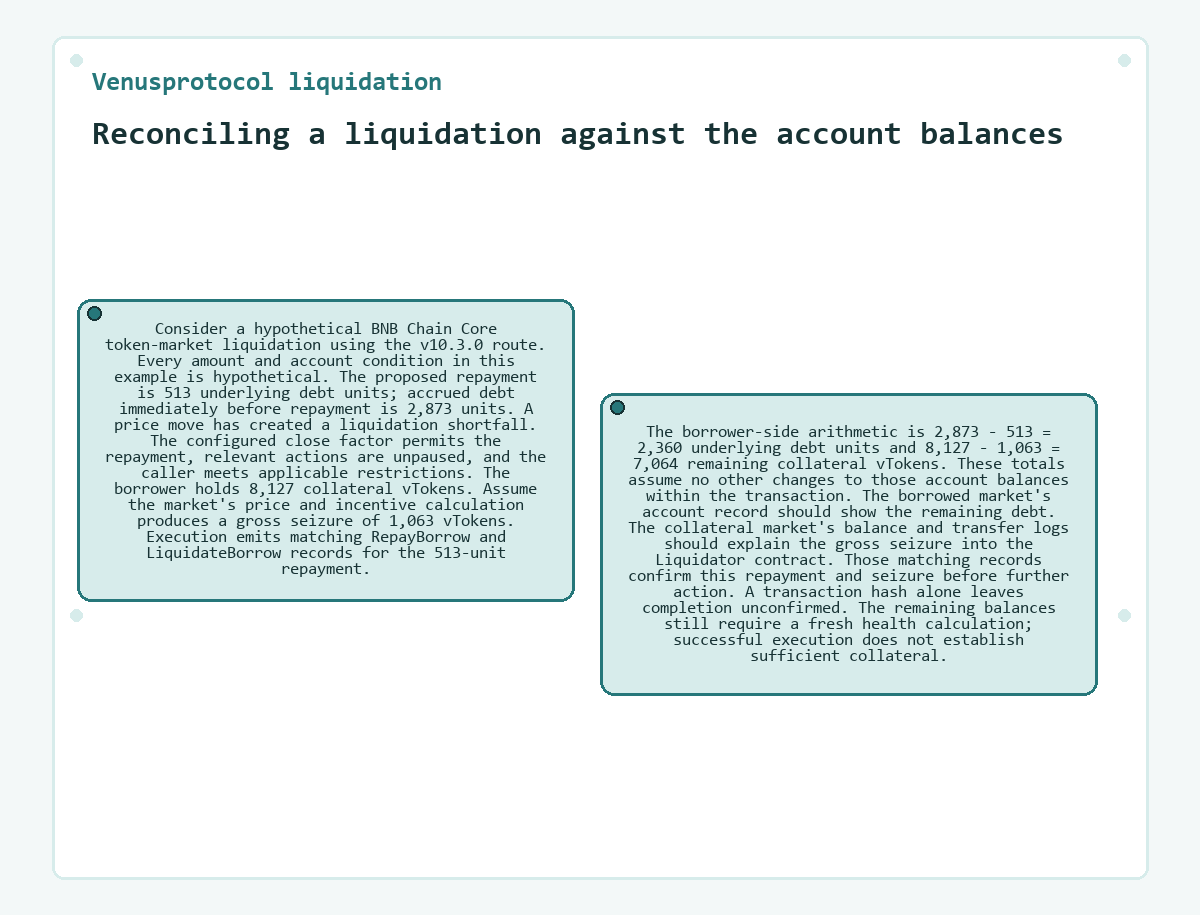
Consider a hypothetical BNB Chain Core token-market liquidation using the v10.3.0 route. Every amount and account condition in this example is hypothetical. The proposed repayment is 513 underlying debt units; accrued debt immediately before repayment is 2,873 units. A price move has created a liquidation shortfall. The configured close factor permits the repayment, relevant actions are unpaused, and the caller meets applicable restrictions. The borrower holds 8,127 collateral vTokens. Assume the market's price and incentive calculation produces a gross seizure of 1,063 vTokens.
Execution emits matching
RepayBorrow
and
LiquidateBorrow
records for the 513-unit repayment. The borrower-side arithmetic is
2,873 - 513 = 2,360
underlying debt units and
8,127 - 1,063 = 7,064
remaining collateral vTokens. These totals assume no other changes to those account balances within the transaction.
The borrowed market's account record should show the remaining debt. The collateral market's balance and transfer logs should explain the gross seizure into the Liquidator contract. Those matching records confirm this repayment and seizure before further action. A transaction hash alone leaves completion unconfirmed. The remaining balances still require a fresh health calculation; successful execution does not establish sufficient collateral.
Voluntary repayment preserves a different collateral outcome
Voluntary repayment and ordinary liquidation both reduce debt by the underlying amount credited. Voluntary repayment draws funds from the payer and does not itself seize collateral. Liquidation uses the liquidator's repayment and removes collateral under the pool's incentive rules. Availability also differs: voluntary repayment needs an executable repayment action, while liquidation adds eligibility and seizure conditions. For an account with both repayment and liquidation transactions, execution order determines which balances each operation encountered.
Why can an eligible liquidation still fail?
An eligible account can still face a rejected call because routing, repayment, and seizure checks apply independently.
Caller and market boundaries
BNB Chain Core uses the Liquidator proxy for the corresponding contract generation. Beacon-based Core Pools on other networks use their own vToken liquidation entry points. Calling an implementation address or importing another network's interface can target the wrong contract. The correct route also determines which contract receives repayment authorization. In BNB Core v10.3.0, borrower-specific liquidation restrictions can limit callers to an allowlist. A public entry point does not override that restriction. The Comptroller also enforces market listing and the relevant action states.
Repayment limits and collateral availability
For ordinary BNB Core liquidation, the close factor caps repayment against debt in the selected borrowed market. It does not apply to the account's combined debt across every market. A larger repayment can fail even with an account shortfall. Forced liquidation bypasses that cap, while retaining the outstanding-debt ceiling. The borrower must have entered the selected collateral market and hold enough of its vTokens for the calculated seizure. Invalid oracle prices, paused liquidation or seizure actions, and incompatible Comptrollers can also prevent execution. Diagnose the returned error or revert before changing the repayment amount.
Small-account treatment and the remaining position
The v4.4.0 beacon-based engine directs small accounts toward different methods. Ordinary, non-forced liquidation requires total collateral value above the configured USD-denominated
minLiquidatableCollateral
. At or below that boundary, an account with liquidation shortfall can require
liquidateAccount
or
healAccount
. The former requires collateral value strictly greater than debt value multiplied by the liquidation incentive. The call must clear every borrow in the account to succeed. The latter handles collateral at or below that amount and seizes all remaining collateral. The caller funds the repayment calculated for each borrow. The method clears the borrower's loan balances and records any unpaid remainder as market bad debt. RepayBorrow and BadDebtIncreased events record that conversion without a corresponding underlying-token payment.
Standalone isolated pools entered a sunset process in December 2025. A paused supply action prevents new deposits of the underlying asset into a legacy position. Repayment requires a listed market and an unpaused action; withdrawal also needs available cash and sufficient account liquidity. After reconciling the liquidation, assess the remaining shortfall before choosing another repayment or a collateral withdrawal.
Venusprotocol liquidation questions, answered
Do I need to approve my collateral before someone can liquidate my loan?
Protocol-authorized collateral seizure does not require the borrower to approve the liquidator. The collateral market checks seizure policy directly. An allowance matters on the payment side: for token repayments through the BNB Core Liquidator route, the liquidator authorizes that contract to spend the repayment asset. Borrower-specific restrictions can still limit who can execute the liquidation.
How much BNB must accompany a native-BNB liquidation call?
For the BNB Core Liquidator v10.3.0 route, native-BNB debt requires msg.value to equal repayAmount, while token-market debt requires msg.value = 0, so sending BNB alongside a token repayment fails the amount check even when the account otherwise meets the liquidation conditions.
Does VAI debt change which loan a liquidator can repay first?
A configured priority rule can require VAI liquidation first on BNB Core. In v10.3.0, it applies when forceVAILiquidate is enabled, VAI liquidation is unpaused, and accrued VAI debt meets or exceeds minLiquidatableVAI. A forced-liquidation flag for the targeted market or borrower-market pair bypasses that priority check.
What happens if redemption of the protocol share fails?
A failed protocol-share redemption does not, by itself, cancel a BNB Core v10.3.0 liquidation. The Liquidator catches that redemption failure and retains the protocol's vTokens for later processing. A committed transaction can still contain the borrower's debt reduction and collateral seizure. This treatment concerns redemption of the protocol share; repayment and seizure must succeed.
Can repaying the remaining loan return collateral a liquidation already seized?
Repaying the remaining debt does not automatically return collateral the liquidation already transferred. Repayment changes the outstanding loan and leaves the earlier seizure intact. Any collateral the borrower still holds remains a separate supply claim, with redemption subject to available liquidity and the account's withdrawal permissions.